How I Quoted a Channel Letter Job in 5 Minutes Using a DXF File
Most channel letter shops quote from experience — height × rate, adjust for gut feel, send it. Here's what it looks like when you quote from the actual DXF geometry instead, start to finish, on a real job that's now on a building.
I want to walk through a real job from my shop — not a hypothetical, not a demo. This is a channel letter set I quoted, fabricated, and installed. I'm showing the full workflow because this is exactly how I use SignCrunch on every job now, and it takes about 5 minutes from DXF to client proposal.
The job is “Sun Massage” — a script font with a logo cloud element. 10 channel letters, 1 cloud cabinet, 4 islands, 15 total objects. This is exactly the kind of job where per-inch pricing hides the real numbers, because script fonts and logo elements have perimeters and areas that block fonts don't come close to.
Step 1: Drop the DXF
The DXF file is the same one I send to the Accubend and the CNC router. I drop it into SignCrunch, and the app reads every vector — perimeters, areas, interior paths, stroke widths. Within seconds I'm looking at the full material breakdown.
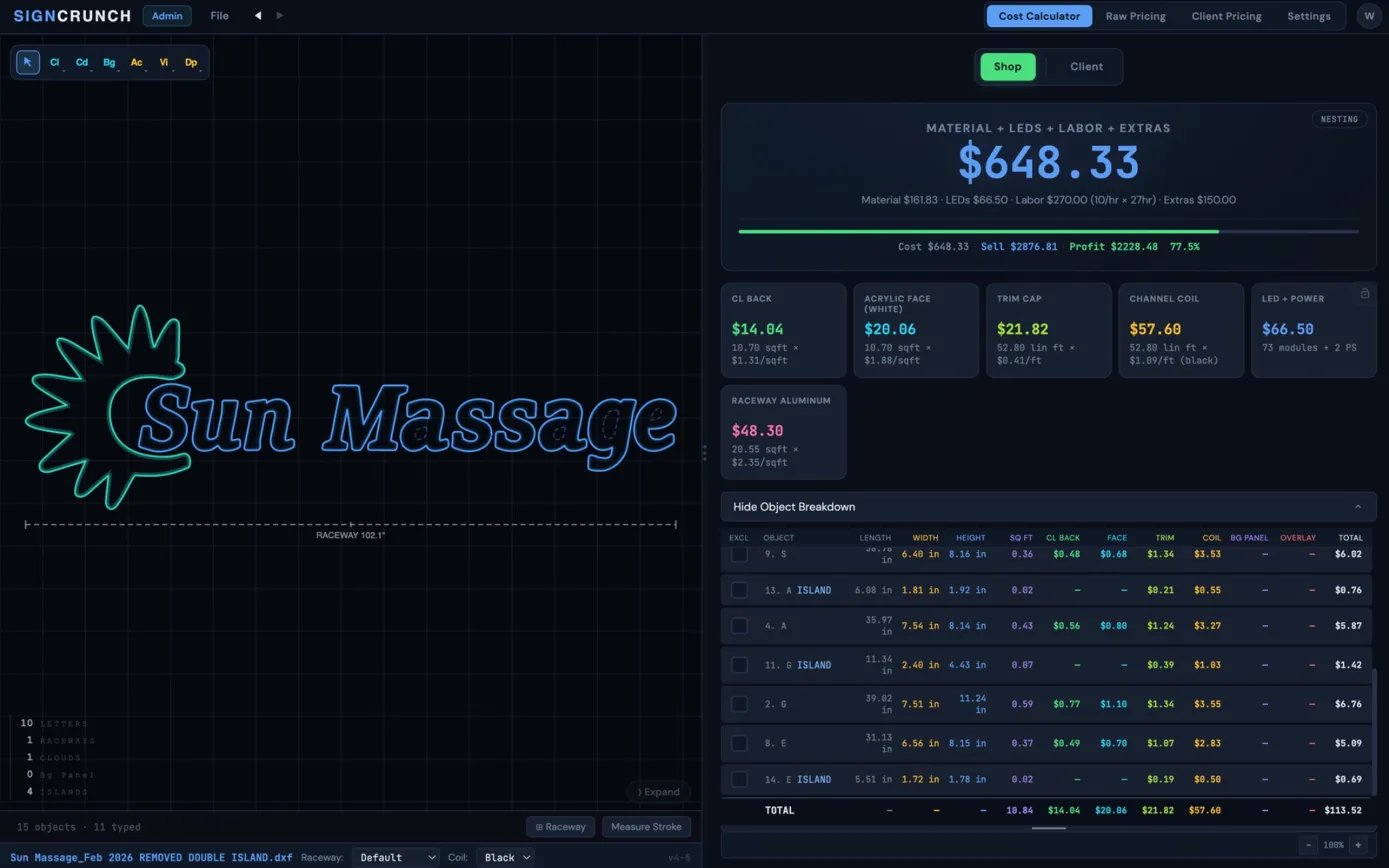
Sun Massage loaded in SignCrunch — 15 objects, 11 typed. Material cards, margin bar, and per-object breakdown all calculated from the DXF geometry.
Here's what the app calculated from the actual letter geometry:
| Material | Quantity | Rate | Cost |
|---|---|---|---|
| CL Backing (ACM) | 10.70 sqft | $1.31/sqft | $14.04 |
| Acrylic Face (White) | 10.70 sqft | $1.88/sqft | $20.06 |
| Trim Cap | 52.80 lin ft | $0.41/ft | $21.82 |
| Channel Coil (Black) | 52.80 lin ft | $1.09/ft | $57.60 |
| LED Modules + Power | 73 modules + 2 PS | — | $66.50 |
| Raceway Aluminum | 20.55 sqft | $2.35/sqft | $48.30 |
Those are my actual vendor prices — what I pay Reece Supply for coil, what Calsak Plastics charges for acrylic sheets, my real LED module cost from my Korean supplier. Not defaults. Not estimates. My numbers.
Material total: $161.83
LEDs: $66.50
Labor: $270.00 (10/hr × 27 hours)
Extras: $150.00
Total cost to me: $648.33
That's my floor on this job. Everything I charge above $648.33 is margin.
Step 2: Generate the Client Pricing
SignCrunch has a Client Pricing view that takes those same measurements and applies your sell rates — per-inch for letters, per-square-foot for cloud cabinets. One click and I've got my pricing summary.
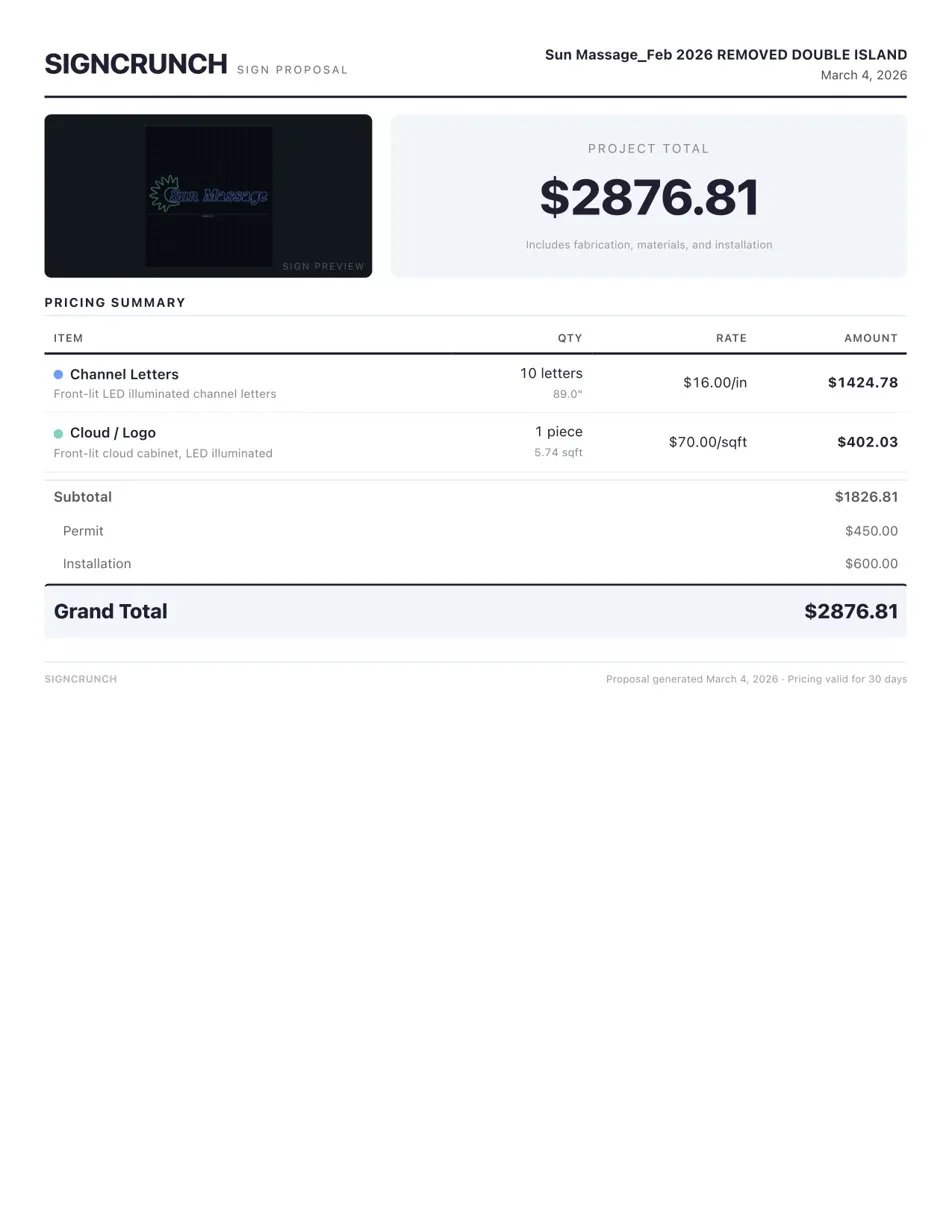
Client proposal generated from the same DXF — 10 letters at $16/inch, 1 cloud at $70/sqft, plus permit and installation.
| Item | Qty | Rate | Amount |
|---|---|---|---|
| Channel Letters | 10 letters, 89.0" | $16.00/in | $1,424.78 |
| Cloud / Logo | 1 piece, 5.74 sqft | $70.00/sqft | $402.03 |
| Permit | — | — | $450.00 |
| Installation | — | — | $600.00 |
| Grand Total | $2,876.81 |
This isn't what the client sees — it's my internal pricing reference. I take that $2,876.81 total and plug it into Joist, the invoicing app I use for all my jobs. The client gets a clean Joist invoice. SignCrunch gives me the number; Joist delivers it.
Step 3: Send the Invoice
I plugged the $2,876.81 into Joist, sent the invoice, client approved, deposit collected, job goes into production.
The whole process from DXF drop to invoice sent: about 5 minutes.
Without SignCrunch, I'd quote this job in 2 minutes using per-inch — same as always. But I wouldn't know my material floor until after the job shipped, if ever. Now I get both in about 5 minutes: the quote I'd send anyway, plus the floor underneath it.
Step 4: Fabricate and Install
The sign went up. 10 front-lit channel letters in script font, 1 illuminated cloud cabinet with the logo, mounted on raceway. The job came together exactly as quoted.

Sun Massage on the shop floor — 10 front-lit script channel letters with illuminated cloud logo cabinet, ready for install.
The Numbers That Matter
Let's look at what this job actually produced:
Cost (materials + LEDs + labor + extras): $648.33
Sell price: $2,876.81
Profit: $2,228.48
Margin: 77.5%
That's a healthy job. But here's where the floor really earns its keep.
I have a competitor down the road who bids $12/inch and $55/sqft on clouds. That's aggressive — well below my $16/inch and $70/sqft. On this exact Sun Massage job, his numbers would look like this:
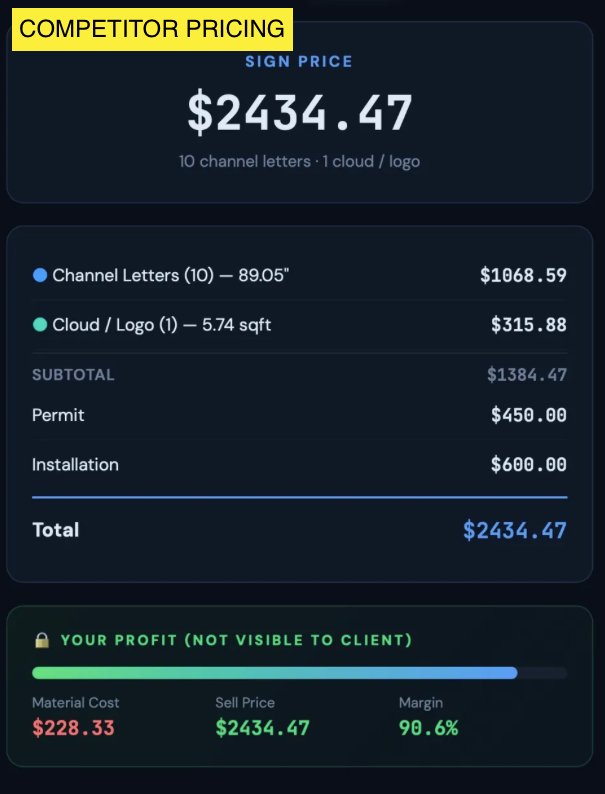
Competitor pricing scenario in Client Mode — $12/inch and $55/sqft. Material cost $228.33, still 90.6% margin.
| My Price | Competitor's Price | |
|---|---|---|
| Channel Letters (89.05") | $16/in → $1,424.78 | $12/in → $1,068.60 |
| Cloud / Logo (5.74 sqft) | $70/sqft → $402.03 | $55/sqft → $315.70 |
| Permit | $450.00 | $450.00 |
| Installation | $600.00 | $600.00 |
| Total | $2,876.81 | $2,434.30 |
His price is $442 less than mine. If the client comes back and says “I got another quote for $2,400” — can I match it?
My material cost on this job is $228.33. At $2,434, that's still $2,206 in margin — 90.6%. I can match that price all day and sleep well.
But I only know that because I can see my floor. Without it, $2,400 on a script set with a cloud element feels risky. With it, it's an easy yes.
That's the difference. Not every job works out this way — a more complex set with heavier materials might have a floor of $800 or $1,000, and suddenly $2,400 is a different conversation. The floor tells you which jobs you can fight for and which ones you should let go.
Why Script Fonts and Logos Need This
This particular job has 52.80 linear feet of trim cap and coil — on a set that's only 89 inches of total letter height. If I were quoting a block font at 89 inches, the perimeter would be significantly less. The script curves and the cloud element drive the material cost way up compared to what per-inch pricing alone would suggest.
The cloud cabinet alone is 5.74 square feet at $70/sqft — $402.03. Per-inch pricing doesn't even have a clean way to quote that. You either eyeball it or you measure it. SignCrunch measures it from the DXF geometry automatically.
Letters with islands — the A and the two E's in this set — each need separate trim cap and coil for the island cutout. The app calculates those automatically too. You can see it in the object breakdown: “A ISLAND” at $0.76, “G ISLAND” at $1.42, “E ISLAND” at $0.69. Small numbers individually, but they add up across every island letter in every job.
What SignCrunch Actually Changes
Let me be clear — I'd still quote this job the same way without SignCrunch. $16/inch for the letters, $70/sqft for the cloud, add permit and installation. That's how the industry works and that's how I've always done it. The per-inch method isn't broken.
But if I wanted to know my floor before SignCrunch? I'd have to sit down in CorelDRAW, measure every letter's perimeter one by one, calculate face areas, look up vendor prices, build a spreadsheet. On a 10-letter script set with a cloud and islands, that's 30 to 45 minutes of work. When you've got jobs in production, installs to schedule, and customers waiting on quotes, nobody has that time. So you skip it. You quote from experience and move on.
That's the burden SignCrunch lifts. I drop the DXF — the same file I'm already sending to the Accubend and the router — and I have my floor in seconds. Not 45 minutes. Seconds. Every perimeter, every area, every island, every material line item calculated from the actual vector geometry.
What's different now is I know my floor is $648.33 before I send the quote. That doesn't change how I price the job — it changes what happens when the client calls back and says “can you do it for $2,200?” or when I find out another shop quoted $2,000.
Without the floor, I'm doing math in my head. Can I make that work? Probably? I think so? With the floor, I subtract: $2,200 minus $648 leaves me $1,552. That's still 70% margin. Yeah, I can do that.
Or maybe I hold firm at $2,876 because I know the margin justifies it. Either way, I'm deciding — not guessing.
That's the whole point. SignCrunch doesn't change how you quote. It removes the time and effort it used to take to see what's underneath your quote — so you can negotiate and compete with confidence instead of instinct.
The Bottom Line
Every fabricator has a workflow. Most of them have a gap between “what the sign costs to make” and “what I charge the customer” — and they fill that gap with experience and instinct. That works. But it means you never see the actual number until after the job is done, if you see it at all.
SignCrunch closes that gap before you send the quote. You see your floor, you set your price, you send the proposal, you win the job. And when the sign goes up on the building, you already know exactly what you made on it.
That's what knowing your floor looks like on a real job.
SignCrunch is live. Solo plan, $39.99/month, 7-day free trial.
Know your floor before you bid. Drop a DXF and see exact material costs for every letter.
Won Lee
Founder of SignCrunch. 20+ years in channel letter fabrication. Building tools to help sign shops know their real costs.