How to Accurately Estimate Channel Letter Material Costs
Per-inch pricing charges the same for every letter — but a 24" block "I" and a 24" block "M" use wildly different amounts of material. Here's how to calculate your actual channel letter material cost instead of guessing.
Every channel letter fabricator has a per-inch price. Maybe it's $16 for standard face-lit, $20 for face and halo, $18 for halo-only. You quote a 12-letter set, multiply height × price × quantity, send it out, and move on to the next job. Easy — you've been doing this for as long as you can remember.
The problem? That formula treats every letter the same. And every letter is not the same. Surely, the thought's crossed your mind about readjusting the formula for the letter "M" — maybe I'll charge "M" as two separate letters. Fine, do that — tally it all up, send it, carry on.
But here's what the actual numbers look like.
A 24-inch block "I" costs $16.60 in raw materials. A 24-inch block "M" in the same font costs $52.48. Same letter height, same per-inch price — but 3.16× the material cost. The "M" has 3× the perimeter and 3.6× the face area. At $16/inch, both letters bill at $384. One costs you $16.60 to make. The other costs $52.48.
I've been fabricating channel letters for 20+ years. For most of that time, I used the same per-inch formula everyone else uses. It works — but I never knew what my material floor actually was on any given job. Most shops don't. If you want to know how to price channel letters with real confidence, you need to start with what they actually cost to make.
The Traditional Method: Channel Letter Cost Per Inch
Per-inch (or "per-upright-inch") pricing is the industry standard for quoting channel letters. The concept is simple: measure the tallest dimension of each letter, multiply by your rate, and that's the price per letter.
For a set of 10 letters at 24 inches and $16/inch, that's $3,840. Quick, easy, and universally understood between wholesale fabricators and their customers.
There's nothing wrong with per-inch pricing as a quoting method. It's how the industry works and how you communicate prices to your customers. The issue is that channel letter cost per inch doesn't tell you what the sign actually costs to make — and without that number, you don't know your floor.
Per-inch pricing is a sales tool. It's not a cost analysis tool.
What Actually Goes Into a Channel Letter
Before we talk about how to calculate channel letter cost, let's account for every raw material. A standard face-lit channel letter uses 6 core materials:
- ACM letter backing — aluminum composite material cut to the letter shape. ACM has largely replaced traditional .040 aluminum for its lower cost and is available from most major distributors like Grimco and N. Glantz.
- Acrylic face — typically 3mm white acrylic, cut to the letter shape plus trim cap overlap. Whether you're buying your sheets from Reece Supply, Grimco, or N. Glantz, the price per 4×8 sheet is what drives this cost — not the letter height.
- Trim cap — the plastic channel that holds the acrylic face, measured in linear feet around the letter perimeter.
- Aluminum channel coil — the return material that wraps around the letter, measured in linear feet by the perimeter and return depth. Coil is typically one of the larger material line items on any channel letter job.
- Raceway aluminum — the mounting structure behind the letters, sized to the overall sign dimensions.
- LED modules + power supplies — interior illumination, quantity depends on the actual interior area and path, not the letter height.
Optional add-ons like background panels, vinyl overlays (translucent or opaque), and digital print overlays add to the total. Each material has a different unit of measure — square feet, linear feet, per-module — and a different cost driver. Letter height alone doesn't capture any of this.
Why Letter Shape Matters More Than Letter Height
This is the part most fabricators feel in their gut but never quantify.
Consider two 24-inch letters in the same block font: an "I" and an "M." Same height. Same per-inch price. Completely different channel letter material cost.
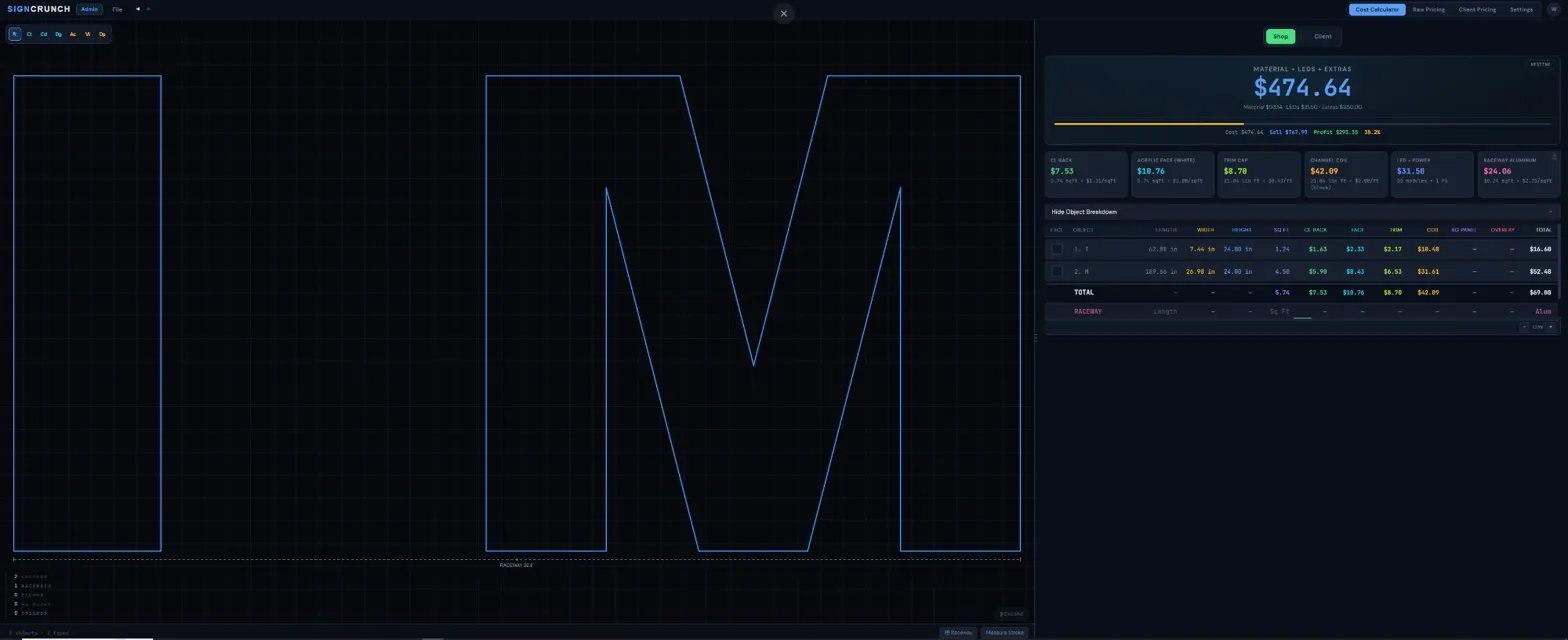
Here are the actual numbers, pulled from a DXF running through SignCrunch:
| Material | 24" Block I | 24" Block M | Difference |
|---|---|---|---|
| Perimeter | 62.88 in | 189.66 in | 3.0× |
| Width | 7.44 in | 26.98 in | 3.6× |
| Face area | 1.24 sqft | 4.50 sqft | 3.6× |
| CL Backing | $1.63 | $5.90 | 3.6× |
| Acrylic face | $2.33 | $8.43 | 3.6× |
| Trim cap | $2.17 | $6.53 | 3.0× |
| Channel coil | $10.48 | $31.61 | 3.0× |
| Total material | $16.60 | $52.48 | 3.16× |
The "M" costs over 3× more in raw materials than the "I" — and neither letter even has an island. Letters with islands (A, B, D, O, P, Q, R) add even more because the island needs its own trim cap, its own coil, and its own LED modules. Put several island letters in a 12-letter set and the material cost variance across the job adds up fast.
Look at the perimeters: the "I" has 62.88 inches of perimeter. The "M" has 189.66 inches — three times as much. That perimeter drives trim cap and coil, which are two of the heavier cost components. And the face area — 1.24 sqft versus 4.50 sqft — means the "M" uses 3.6× more acrylic and 3.6× more backing material.
Now think about serif fonts, decorative scripts, logos with custom shapes. The more complex the geometry, the wider the gap between what you charge per inch and what you spend in channel letter raw materials.
What Knowing Your Floor Actually Gets You
Here's the thing — at $16/inch, you're making good money on both the "I" and the "M." Every shop quoting in this range is profitable. That's not the issue.
The issue is what happens when a competitor across town bids $12/inch on the same job. Can you match that and still be comfortable? Without knowing your material floor, you're guessing.
With the floor, you're deciding. If your raw materials on a block set come out to $4/inch, you know you can go to $12 and still have solid margin for labor, overhead, and profit. If it's a complex script set and your materials come out to $8/inch, you know $12 is tighter — maybe you match it, maybe you don't. But either way, you're making that decision with a number in front of you instead of a gut feeling.
The shops that know their floor have an edge in competitive situations. Not because they bid lower — but because they know exactly how low they can go when they want to win a job. That's leverage.
Why Channel Letter Estimating Is Hard to Do By Hand
Getting accurate channel letter material costs requires measuring the actual geometry of every letter — perimeters, areas, stroke widths, interior paths. For a simple 5-letter block set, you might spend 20-30 minutes doing this manually in your design software. For a 15-letter script set with logos, you're looking at 1-2 hours.
Most shops don't have that time. You've got jobs in production, installs to schedule, customers waiting for quotes. So the per-inch formula wins by default — not because it's accurate, but because it's fast.
How SignCrunch Gives You the Floor
We built SignCrunch to close this gap. Drop your DXF file — the same file you send to your bender or CNC router — and the app measures the actual vector geometry of every object. It calculates square footage, perimeters, and interior paths automatically, then applies your vendor pricing to produce an exact material cost per letter and per job.
You plug in your actual vendor prices — what you're paying Reece Supply for a roll of coil, what Grimco charges you for a 4×8 acrylic sheet, what your LED modules cost from whoever you buy them — and get your cost floor in seconds instead of hours.
That raw material total is your floor. Everything above it is labor, overhead, and profit. When you know the floor, you can bid with confidence — whether you're holding your price or sharpening your pencil to win a competitive job.
What You Can Do Right Now
Even without software, you can start getting closer to your real channel letter material cost today:
- Know your vendor costs cold. Pull up your last invoices from Reece, Glantz, Grimco — whoever you're buying from. What do you actually pay per 4×8 sheet of acrylic? Per roll of coil? Per LED module? If you're guessing these numbers, everything downstream is wrong.
- Separate your material cost from your per-inch price. Your per-inch rate is for quoting customers. Your material cost is for knowing your floor. They're two different numbers serving two different purposes.
- Pay extra attention to script fonts and complex shapes. These are where the gap between per-inch pricing and actual material cost is widest. If you can't measure the actual geometry, at minimum add a 15-25% material buffer on script and decorative sets.
- Track your actual material usage. After a job ships, compare what you actually used versus what your per-inch estimate implied. The patterns will tell you where your margins are fat and where they're thinner than you thought.
The Bottom Line
Per-inch pricing isn't going away, and it doesn't need to. It's a fast, simple way to communicate prices in the channel letter world. But it was never designed to tell you what a sign costs to make.
The shops that know their material floor have an edge: they can bid confidently on any job, they know exactly which sets have fat margins and which are thinner, and they can compete strategically when someone else goes lower — because they know how low they can go.
That's what knowing your floor gives you. Not a replacement for per-inch pricing — the cost baseline underneath it.
SignCrunch is now live. Solo plan, $39.99/month, 7-day free trial.
Know your floor before you bid. Drop a DXF and see exact material costs for every letter. Start Free Trial →
Won Lee
Founder of SignCrunch · 20+ years in channel letter fabrication · Building tools to help sign shops know their real costs.