Why Per-Inch Channel Letter Pricing Is Broken
A 24-inch block letter "I" costs $10.12 in raw materials. A 24-inch block "W" — same font, same height — costs $39.80. That's 3.9× the material for a letter that bills at the exact same per-inch price. Here's what every letter A through Z actually costs to make.
Per-inch pricing is how this industry has quoted channel letters since the 1980s. It's fast, everyone understands it, and it works as a communication tool between you and your customers. I used it for 20+ years at my shop. There's nothing wrong with it as a quoting method.
But per-inch pricing has a fundamental blind spot: it treats every letter the same. A 24-inch "I" and a 24-inch "W" both quote at $384 (at $16/inch). One is a simple vertical stroke. The other has four diagonal legs, is 33 inches wide, and uses nearly 15 feet of coil. Per-inch pricing can't see the difference. Your material costs can.
I built SignCrunch to answer a question I couldn't answer with per-inch pricing: what does each letter on this sign actually cost me in raw materials? Not the whole job averaged out — each individual letter. Once I had that number, I could see my floor. Everything above the floor is labor, overhead, and profit.
Here's what the floor looks like across the entire alphabet.
Every Letter A–Z, Sorted by Material Cost
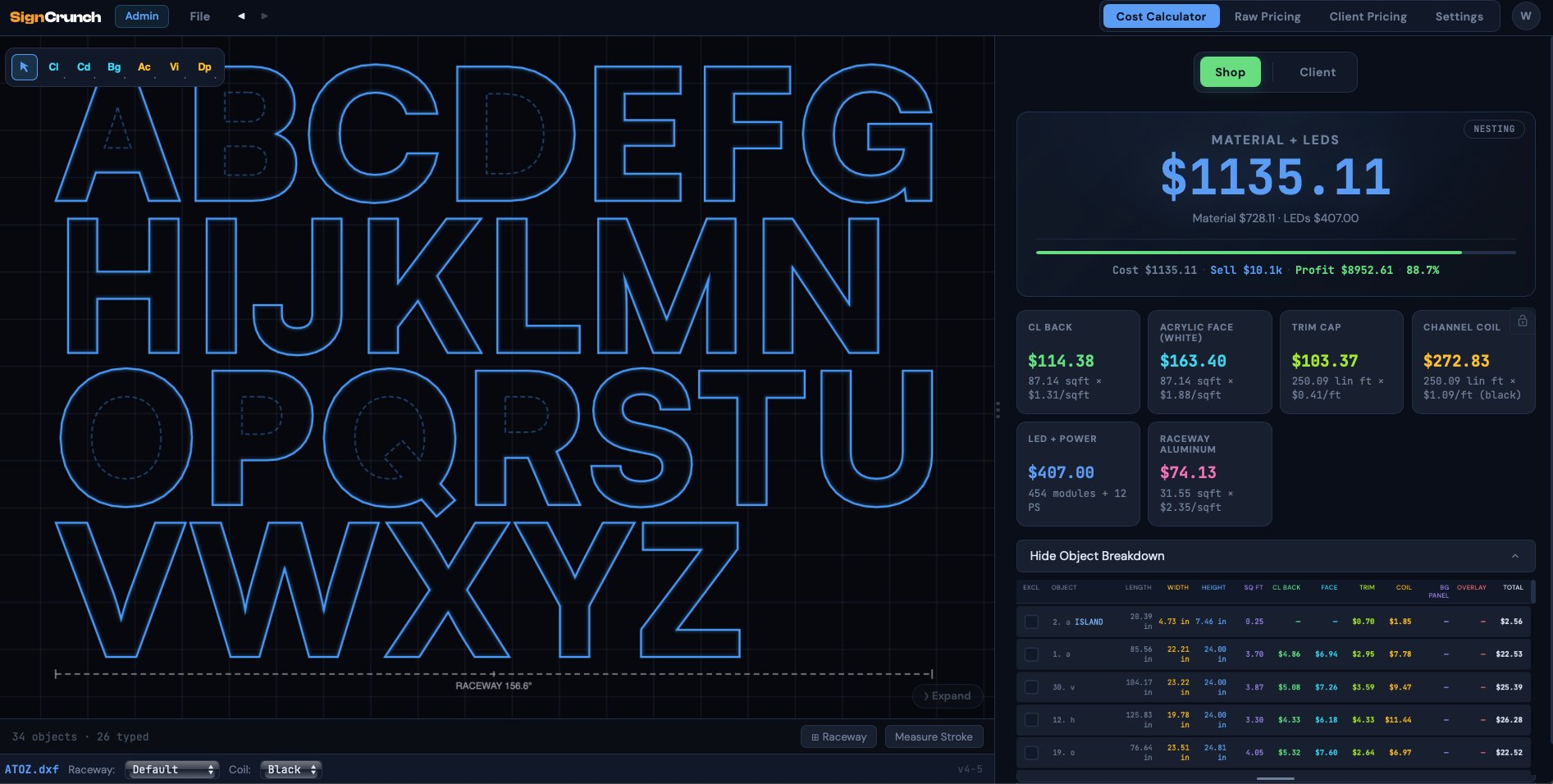
I ran all 26 letters at 24 inches in the same block font. Material prices are the lowest I could source from Reece Supply, N. Glantz, Grimco, and Calsak Plastics — this is the actual floor, not inflated estimates.
Each letter's total includes backing, acrylic face, trim cap, and channel coil. LED modules are calculated separately ($407 for the full set of 26 — 454 modules and 12 power supplies).
| Rank | Letter | Perimeter | Width | Area | Backing | Face | Trim | Coil | Total |
|---|---|---|---|---|---|---|---|---|---|
| 1 | I | 58.5 in | 5.3 in | 0.88 sqft | $1.15 | $1.64 | $2.02 | $5.32 | $10.12 |
| 2 | L | 77.4 in | 14.7 in | 2.45 sqft | $3.22 | $4.60 | $2.67 | $7.04 | $17.53 |
| 3 | J | 80.4 in | 15.7 in | 2.67 sqft | $3.50 | $5.00 | $2.77 | $7.31 | $18.58 |
| 4 | F | 95.4 in | 15.3 in | 2.55 sqft | $3.34 | $4.77 | $3.29 | $8.67 | $20.07 |
| 5 | T | 85.8 in | 18.9 in | 3.15 sqft | $4.13 | $5.90 | $2.95 | $7.80 | $20.78 |
| 6 | P | 77.2 in | 17.9 in | 2.98 sqft | $3.92 | $5.59 | $3.52 | $9.27 | $22.30 |
| 7 | E | 116.2 in | 15.2 in | 2.54 sqft | $3.33 | $4.76 | $4.00 | $10.56 | $22.66 |
| 8 | Y | 90.8 in | 21.5 in | 3.58 sqft | $4.70 | $6.71 | $3.13 | $8.25 | $22.79 |
| 9 | Z | 111.3 in | 17.6 in | 2.93 sqft | $3.85 | $5.50 | $3.84 | $10.12 | $23.31 |
| 10 | S | 117.9 in | 18.0 in | 3.10 sqft | $4.07 | $5.82 | $4.06 | $10.72 | $24.67 |
| 11 | A | 85.6 in | 22.2 in | 3.70 sqft | $4.86 | $6.94 | $3.65 | $9.63 | $25.09 |
| 12 | U | 115.4 in | 19.8 in | 3.35 sqft | $4.40 | $6.28 | $3.98 | $10.49 | $25.15 |
| 13 | R | 98.1 in | 18.6 in | 3.11 sqft | $4.08 | $5.83 | $4.25 | $11.22 | $25.37 |
| 14 | V | 104.2 in | 23.2 in | 3.87 sqft | $5.08 | $7.26 | $3.59 | $9.47 | $25.39 |
| 15 | B | 81.0 in | 18.0 in | 3.01 sqft | $3.94 | $5.63 | $4.36 | $11.51 | $25.44 |
| 16 | K | 122.6 in | 20.2 in | 3.36 sqft | $4.41 | $6.30 | $4.22 | $11.14 | $26.08 |
| 17 | H | 125.8 in | 19.8 in | 3.30 sqft | $4.33 | $6.18 | $4.33 | $11.44 | $26.28 |
| 18 | D | 80.2 in | 21.0 in | 3.50 sqft | $4.60 | $6.57 | $4.26 | $11.24 | $26.66 |
| 19 | X | 119.2 in | 22.3 in | 3.71 sqft | $4.87 | $6.96 | $4.11 | $10.84 | $26.78 |
| 20 | C | 117.4 in | 23.0 in | 3.96 sqft | $5.20 | $7.43 | $4.04 | $10.67 | $27.34 |
| 21 | N | 135.9 in | 20.5 in | 3.42 sqft | $4.48 | $6.40 | $4.68 | $12.35 | $27.92 |
| 22 | O | 76.6 in | 23.5 in | 4.05 sqft | $5.32 | $7.60 | $4.14 | $10.92 | $27.97 |
| 23 | Q | 84.6 in | 23.5 in | 4.33 sqft | $5.68 | $8.11 | $4.73 | $12.49 | $31.01 |
| 24 | G | 147.0 in | 23.0 in | 3.95 sqft | $5.18 | $7.40 | $5.06 | $13.37 | $31.01 |
| 25 | M | 166.2 in | 24.6 in | 4.09 sqft | $5.37 | $7.67 | $5.73 | $15.11 | $33.88 |
| 26 | W | 174.7 in | 33.7 in | 5.62 sqft | $7.37 | $10.53 | $6.02 | $15.88 | $39.80 |
Material total for all 26 letters: $653.98
LEDs + power supplies: $407.00 (454 modules, 12 PS)
Combined floor: $1,060.98
At $16/inch, this full A–Z set quotes at $9,984. The material floor — using the cheapest supplier prices available — is $1,060.98. That leaves $8,923 for labor, overhead, and profit. Nobody's losing money here. But the margins aren't distributed the way per-inch pricing suggests.
What the Numbers Actually Show
The cheapest letter to fabricate is "I" at $10.12. The most expensive is "W" at $39.80. Both bill at $384 under per-inch pricing. That's a $29.68 material gap that per-inch pricing treats as zero.
Look at where coil drives the cost. The "W" uses 174.7 inches of perimeter — nearly 15 feet of channel coil at $15.88. The "I" uses 58.5 inches — under 5 feet at $5.32. Coil is the single biggest material cost on every letter, and it's entirely determined by the letter's shape, not its height. That's why coil cost varies so dramatically between letters — and why per-inch pricing can't account for it.
The same pattern shows up in every material. The "W" needs 5.62 sqft of backing and acrylic face — the "I" needs 0.88 sqft. That's 6.4× the sheet material for the same letter height. Trim cap follows the perimeter, so it tracks coil: $6.02 for the "W," $2.02 for the "I."
Letters with islands — A, B, D, O, P, Q, R — carry extra trim and coil for their interior counters. The "B" has two islands. The "Q" has a large one. Those interior perimeters add material cost that doesn't show up in the letter height at all.
Why This Matters for Your Shop
None of this means per-inch pricing is wrong. It's the standard for a reason — it's fast, clients understand it, and it keeps you profitable across jobs. The issue is that it's a quoting tool, not a costing tool.
Here's where the difference matters.
A competitor bids $12/inch on a job you quoted at $16. That's $288 per letter versus your $384. Can you match it and still make money? Per-inch pricing can't answer that — it doesn't know what the letter costs to make. But if you know the "W" costs $39.80 in materials and the "I" costs $10.12, you can look at the actual letter mix on that specific job and decide whether $12/inch covers your floor plus enough margin to be worth it.
That's the difference between deciding and guessing. Knowing your material floor doesn't change how you quote — it changes how you compete. A job heavy on I's, L's, and T's has a lower floor than a job heavy on M's, W's, and G's. Per-inch pricing charges the same for both. Your material costs don't.
I deal with this every day at my shop. Competitors are quoting wholesale at $12/inch and under. That's one of the main reasons I built SignCrunch — I needed to know whether I could match those numbers and still cover my materials. Sometimes the answer is yes. Sometimes it's no. Either way, I'm making that call from a number, not a feeling.
The Real Cost Driver: Shape, Not Height
If you look at the table, the pattern is clear. The cheapest letters are narrow and simple: I, L, J, F, T. The most expensive are wide and complex: W, M, G, Q, N. Height is the same across all of them — 24 inches. What changes is the perimeter and area, which are driven entirely by the letter's shape.
Coil is the biggest single cost on every letter in this table. It ranges from $5.32 (I) to $15.88 (W). Backing and face track with area — wider letters use more sheet material. Trim cap follows the same path as coil since it covers the same perimeter.
This is why two sign jobs with identical letter heights, identical letter counts, and identical per-inch quotes can have completely different material floors. The letters themselves determine the cost — not the height.
How SignCrunch Calculates This
Every number in the table above came from loading a single DXF file into SignCrunch. The app reads the actual vector geometry of each letter — perimeters, areas, bounding boxes, islands — and calculates material costs from real dimensions. No estimation, no averages, no rules of thumb.
You plug in your vendor prices from whoever you buy from — Reece Supply, Grimco, N. Glantz, Calsak Plastics — and the app calculates your floor using your actual costs, not industry averages. The prices in this post are the lowest I could find across all four suppliers. Your floor will be different depending on what you pay and who you buy from.
The calculation takes about 30 seconds from DXF drop to full cost breakdown. That floor number — plus LEDs, labor, and overhead — is what it actually costs you to build the sign. Everything above it is your margin.
SignCrunch is now live. Solo plan, $39.99/month, 7-day free trial.
Know your floor before you bid. Drop a DXF and see exact material costs for every letter — backed by real geometry, not per-inch averages. Start Free Trial →
Won Lee
Founder of SignCrunch · 20+ years in channel letter fabrication · Building tools to help sign shops know their real costs.